 CloudGo
A good answer has to fit the environment.
General cloud guidance is a starting point. A decision inside a real organization also depends on architecture, internal standards, team capacity, historical choices, and business constraints.
- Connect what the prompt leaves outA short prompt rarely carries every dependency and business priority. A shared knowledge foundation helps bring those considerations into the conversation.
- Keep evidence available for reviewTeams need to understand what informed a recommendation. Source context and explicit assumptions help them evaluate whether it fits.
- Reuse what your organization knowsKnowledge becomes more useful when it can carry across projects and tools, rather than needing to be assembled in every new chat.
Executive Summary
CloudGo.ai was evaluated against Claude and Cursor across four business-critical workflows: cloud discovery, cost analysis, migration planning, and security validation. Across all four, CloudGo.ai was the only system that operated on live infrastructure data, produced deployable output, and passed industry-standard validation without manual intervention.
| Dimension | CloudGo.ai | Claude | Cursor |
|---|---|---|---|
| Live cloud access | Yes | No | Partial |
| Usage-aware cost modeling | Yes | No | Limited |
| Migration optimization | Yes | No | No |
| Validation passed | 100% | Failed | Failed |
| Deployment-ready output | Yes | No | No |
Bottom line: CloudGo.ai reduces cloud risk, engineering effort, and infrastructure cost by operating as a purpose-built cloud intelligence system rather than a general LLM.
Part 1: Cloud Inventory and Usage Data
CloudGo.ai automatically discovered live cloud infrastructure, including compute, storage, IAM, usage metrics, and security configuration. It surfaced utilization data, encryption settings, tagging gaps, and IAM activity without requiring user scripts or credentials setup. Claude could not access cloud environments and required the user to manually extract and paste data. Cursor attempted discovery via local CLI execution, required credentials, took longer, and still produced an incomplete inventory.
Business gain: Eliminates manual inventory work, reduces blind spots that lead to cost overruns and security gaps, and enables faster, more reliable decision-making based on actual infrastructure state.
View evidence: Inventory prompt and responses
Shared Evaluation Prompt
"The attached AWS account has a few EC2 instances, S3 buckets, a DynamoDB table, and more. Give me a detailed breakdown of my general cloud infrastructure along with recent usage info."
Claude Response
CloudGo.ai Response
Cursor Response
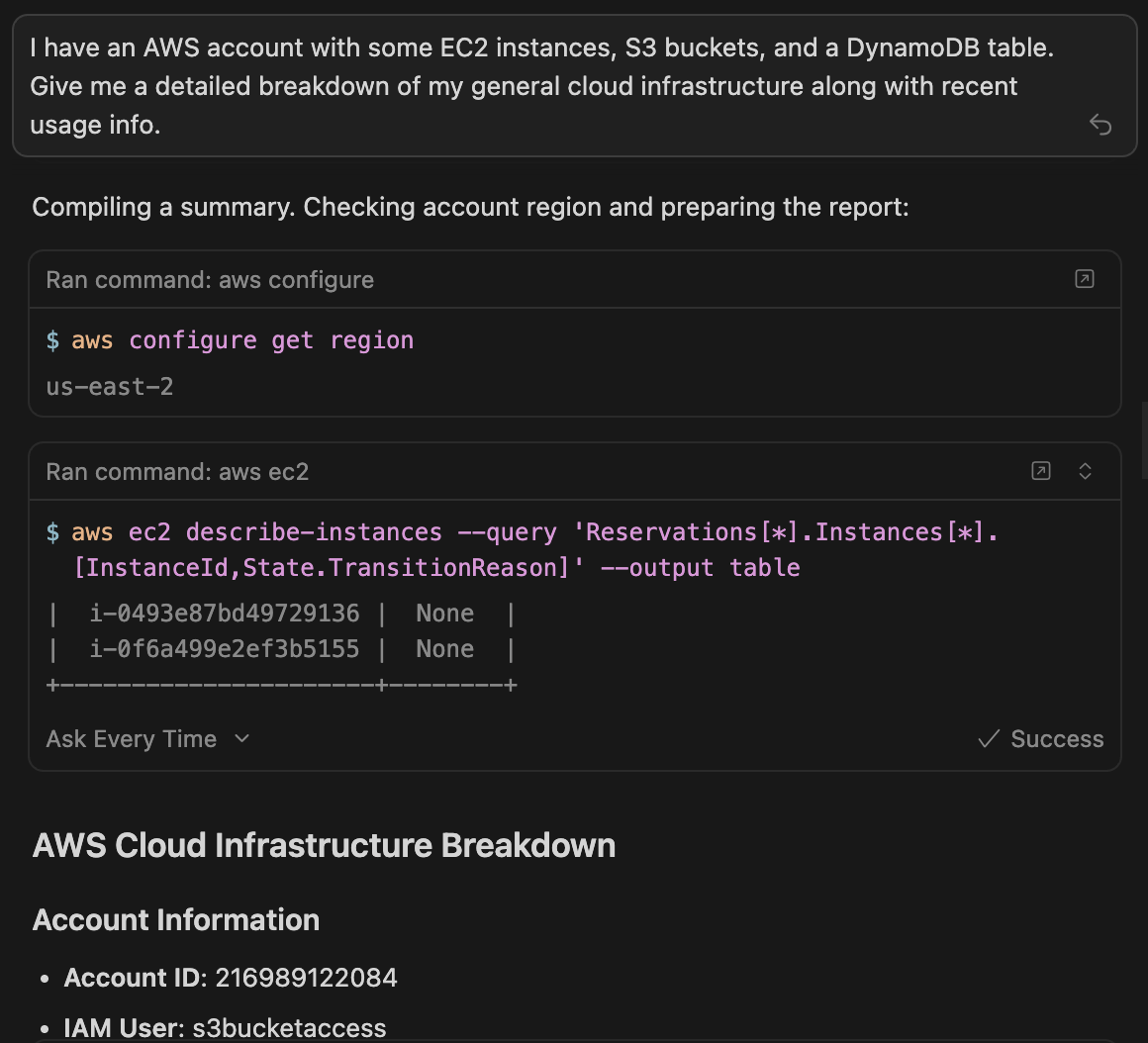
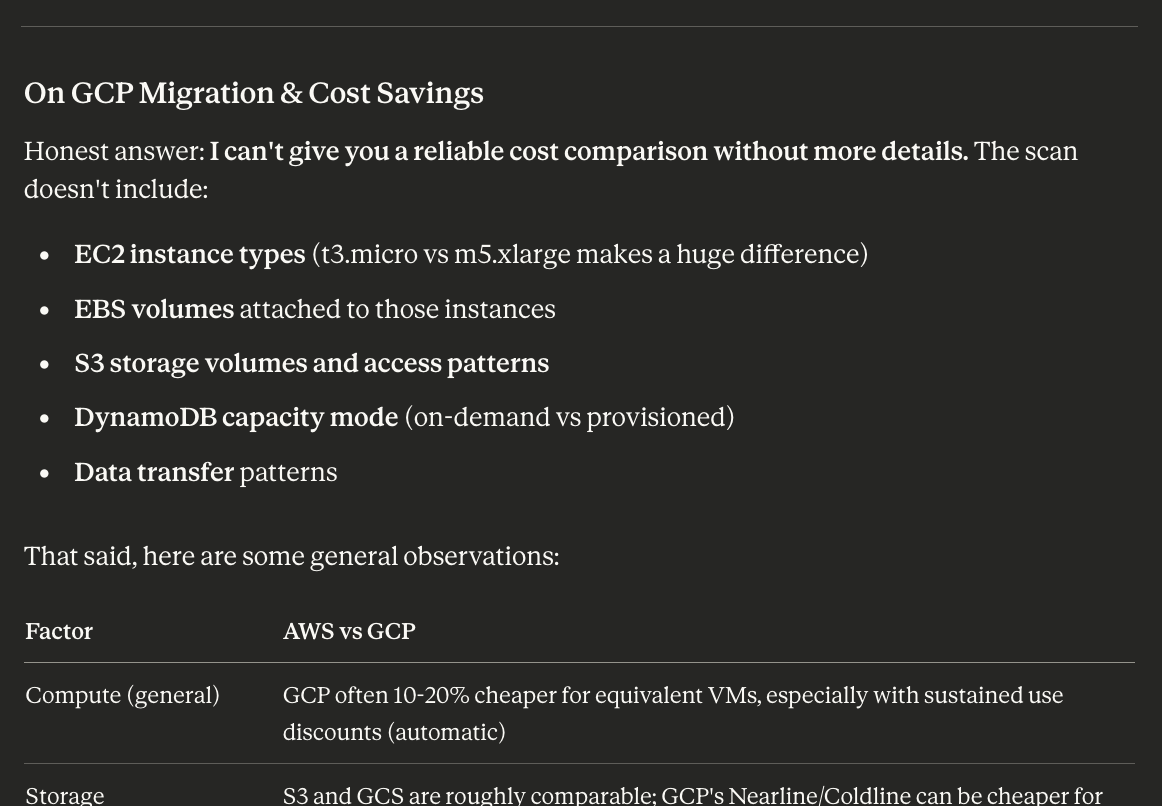
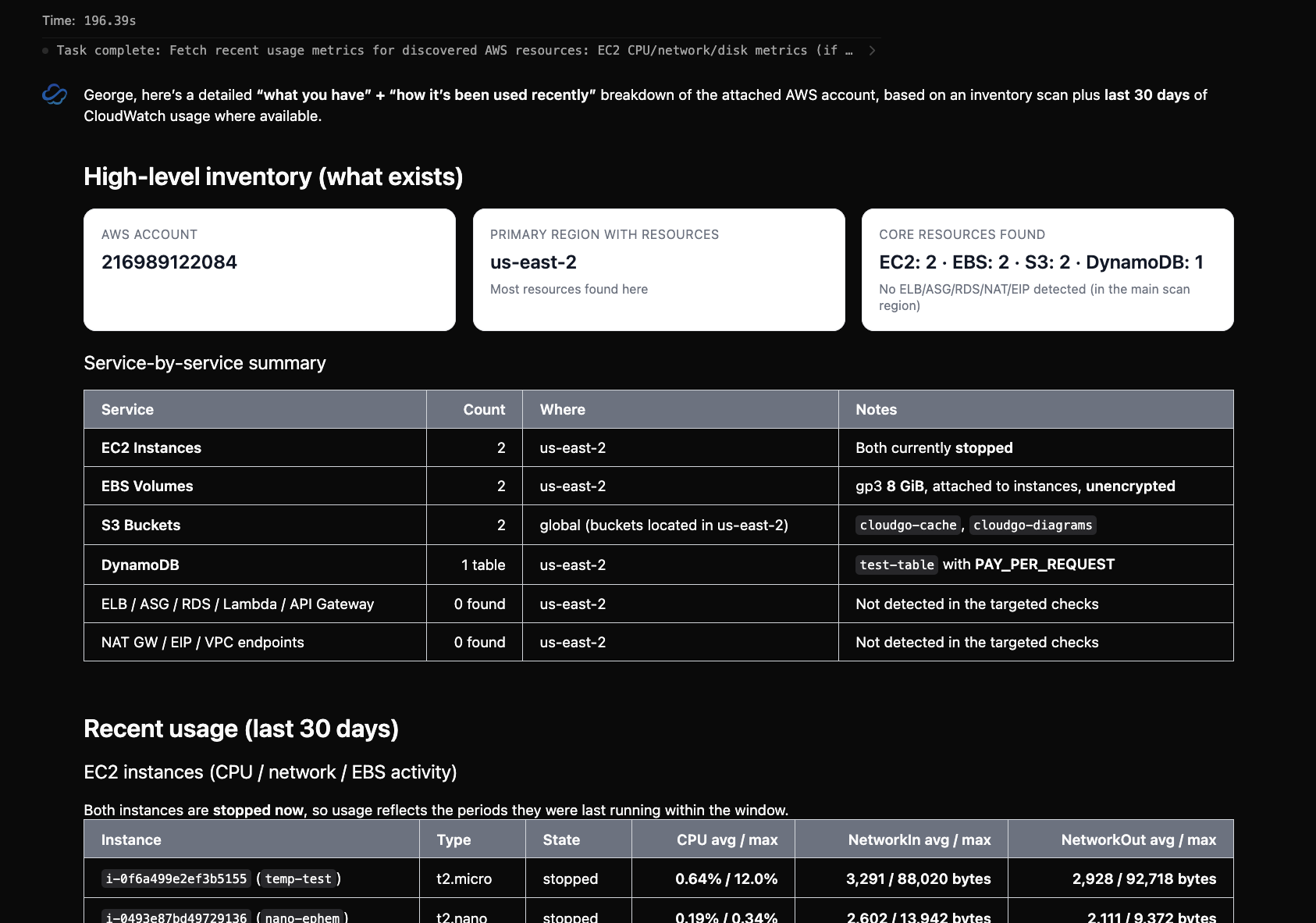
CloudGo.ai immediately called its internal scanning tools, scan_cloud_infrastructure and get_resource_usage, and returned a structured breakdown within seconds. The response included specific instance IDs, CPU utilization percentages, S3 bucket sizes down to the object count (117k+ in one bucket), encryption settings, versioning status, and DynamoDB read/write activity over the past 14 days. It also surfaced metadata we didn't mention in the prompt, like recent IAM user activity and service accounts.
CloudGo.ai returned a comprehensive, structured inventory in seconds using native cloud discovery tools. Claude can't access your cloud at all. Cursor can run CLI commands but takes longer, requires local setup, and still produces an incomplete picture.
Part 2: Answering Questions About Your Infrastructure (Cost Analysis)
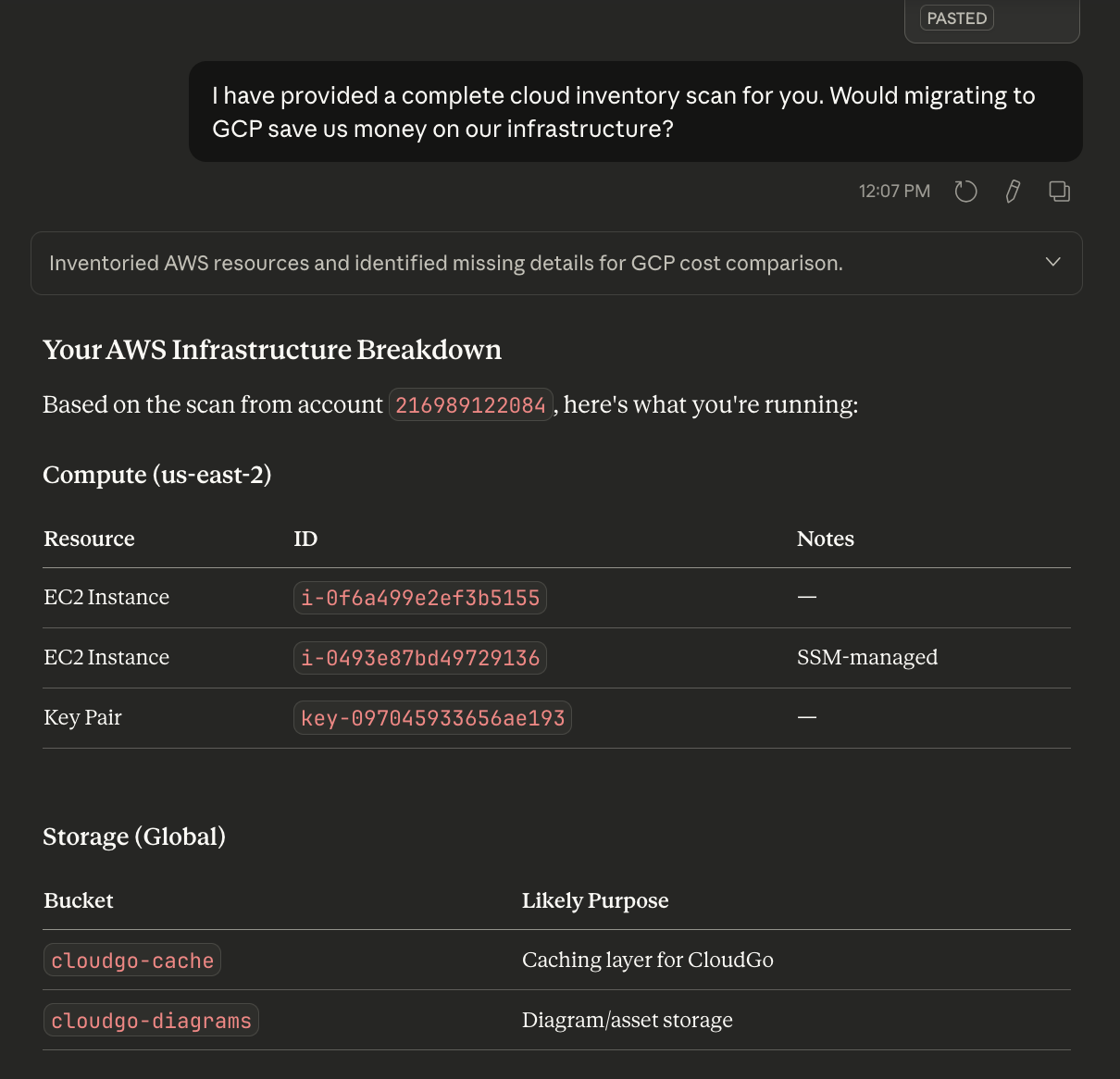
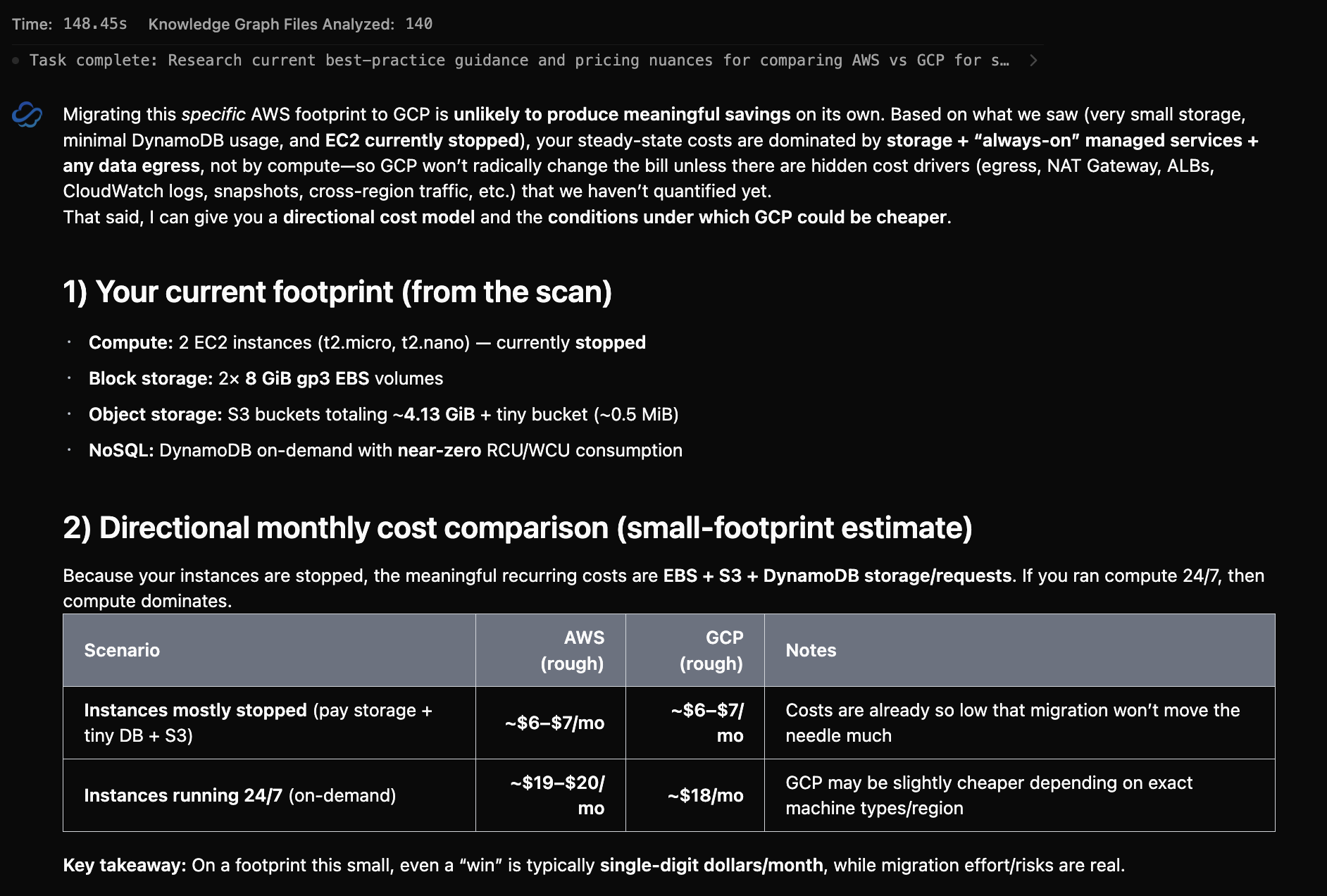
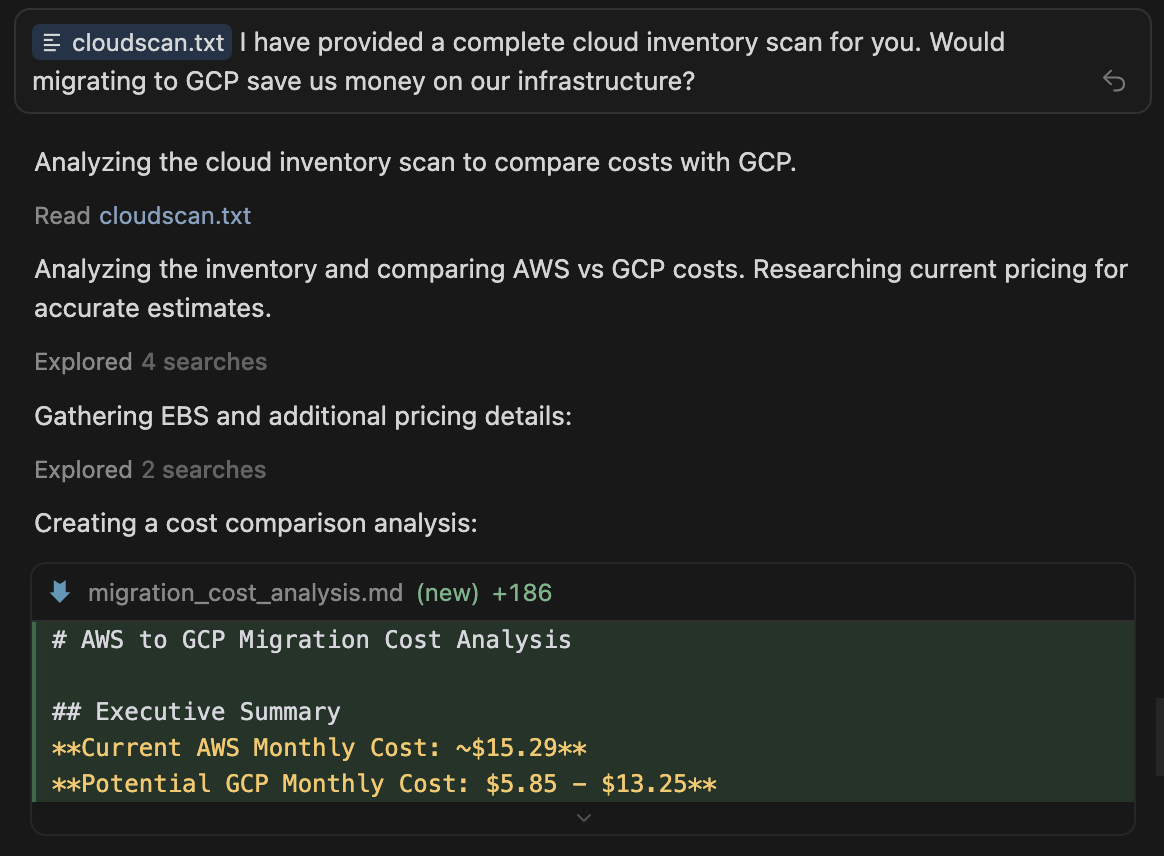
CloudGo.ai used real usage data to build a directional cost model and explicitly identified when migration savings were marginal. It accounted for workload behavior (e.g., stopped instances), surfaced hidden cost drivers, and linked recommendations to verified provider documentation. Claude declined to provide a reliable cost comparison even when given full scan data. Cursor produced confident cost estimates but ignored operational overhead and hidden costs, overstating migration benefits.
Business gain: Prevents unnecessary migrations, avoids false savings assumptions, and supports financially defensible cloud decisions.
View evidence: Inventory prompt and responses
Shared Evaluation Prompt
"I have provided a complete cloud inventory scan for you. Give me a cost analysis; would migrating to GCP potentially save us money on our infrastructure?" (Or, for CloudGo.ai, only “Give me a cost analysis; would migrating to GCP potentially save us money on our infrastructure?"
Claude Response
CloudGo.ai Response
Cursor Response
CloudGo.ai delivered a nuanced, realistic assessment. It pulled specific details from the scan: instance types (t2.micro, t2.nano), EBS volume sizes (2× 8 GiB gp3), S3 bucket sizes (4.13 GiB), and DynamoDB usage patterns, and used them to build a directional cost model. The response included a comparison table showing AWS vs GCP costs under different scenarios (instances stopped vs running 24/7) and explicitly called out that on a footprint this small, even a win is single-digit dollars per month while migration effort is real. It also referenced 140 Terraform knowledge graph files to surface relevant documentation links for GCE pricing, GCS storage classes, DynamoDB pricing, and Firestore pricing.
CloudGo.ai provided the most complete and honest assessment by combining live scan data with knowledge graph context. It didn't just calculate costs, it explained the tradeoffs and linked to source documentation. Claude couldn't act on the data even when provided. Cursor gave actionable numbers but missed the bigger picture.
Part 3: Generating a Migration Plan
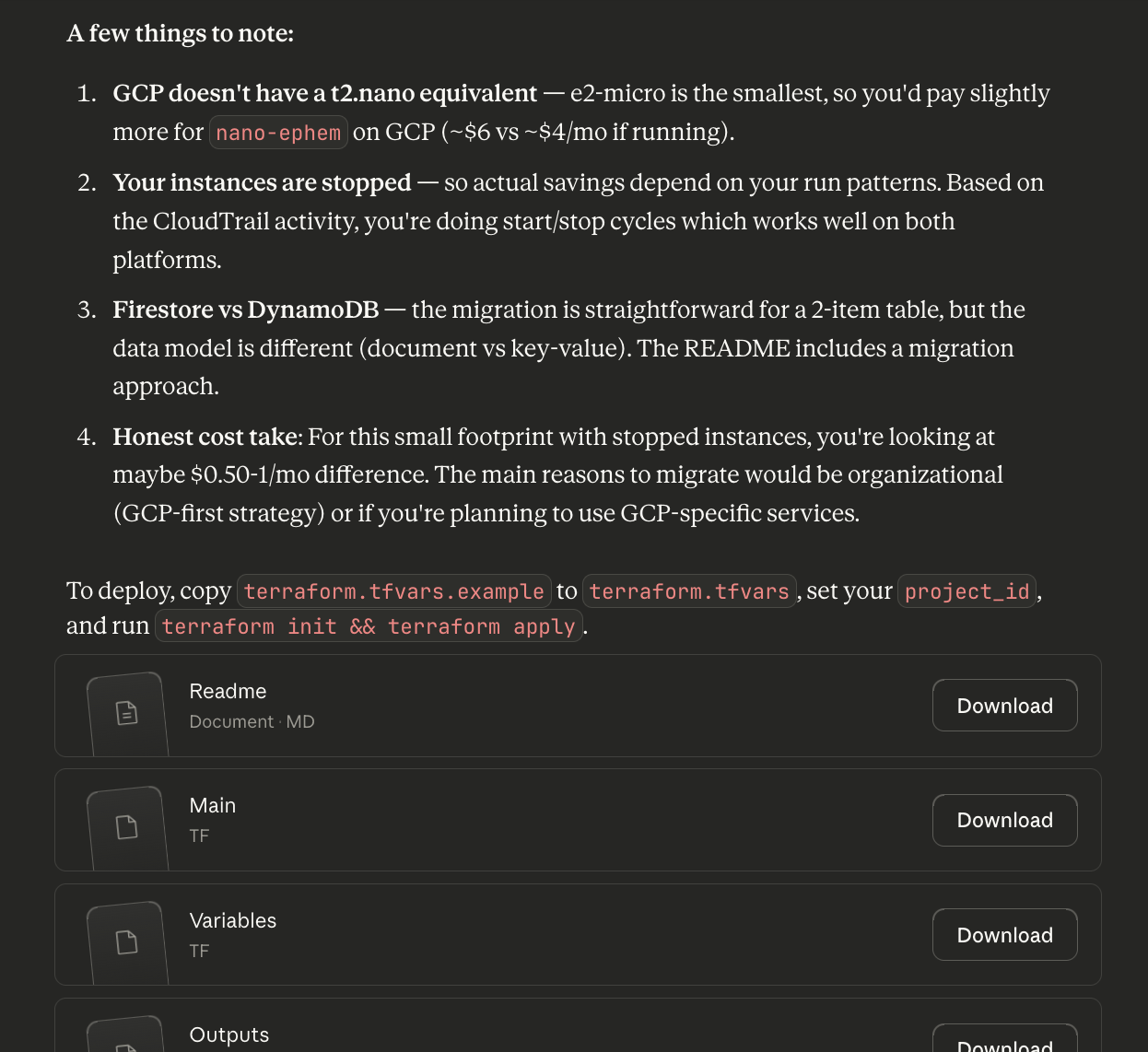
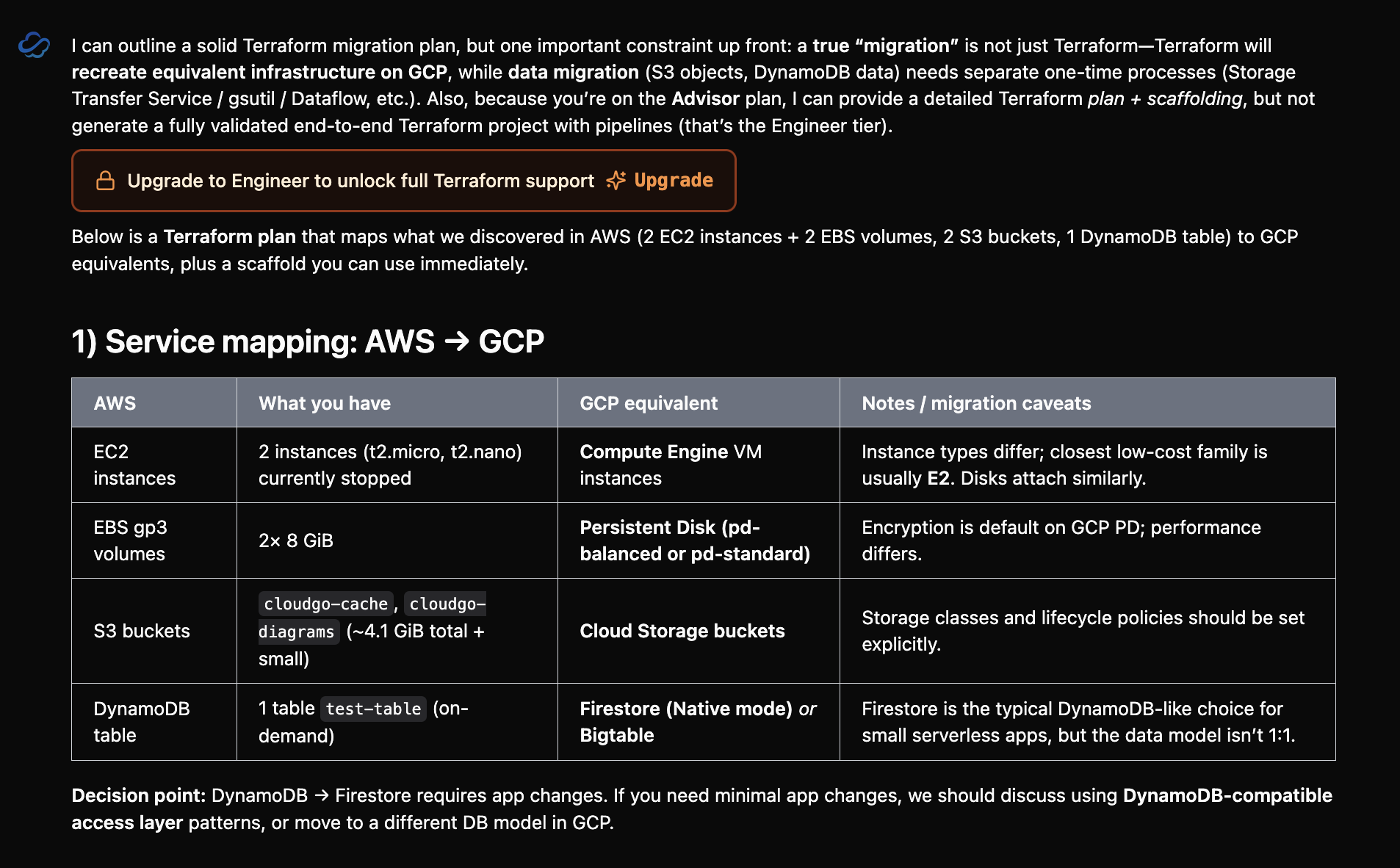
CloudGo.ai redesigned the infrastructure to match the destination cloud’s cost and security model, replacing idle VMs with serverless services, selecting lower-cost regions, simplifying networking, and consolidating IAM. Claude produced a 1:1 translation that preserved inefficiencies and security exposure. Cursor generated Terraform that failed deployment and introduced unnecessary cost and complexity.
Business gain: Achieves 75–90% potential compute cost reduction for sporadic workloads, lowers operational overhead post-migration, and reduces the attack surface by default.
View evidence: Inventory prompt and responses
Shared Evaluation Prompt
"The attached AWS account has a few EC2 instances, S3 buckets, a DynamoDB table, and more. Give me a detailed breakdown of my general cloud infrastructure along with recent usage info."
Claude Response
CloudGo.ai Response
Cursor Response
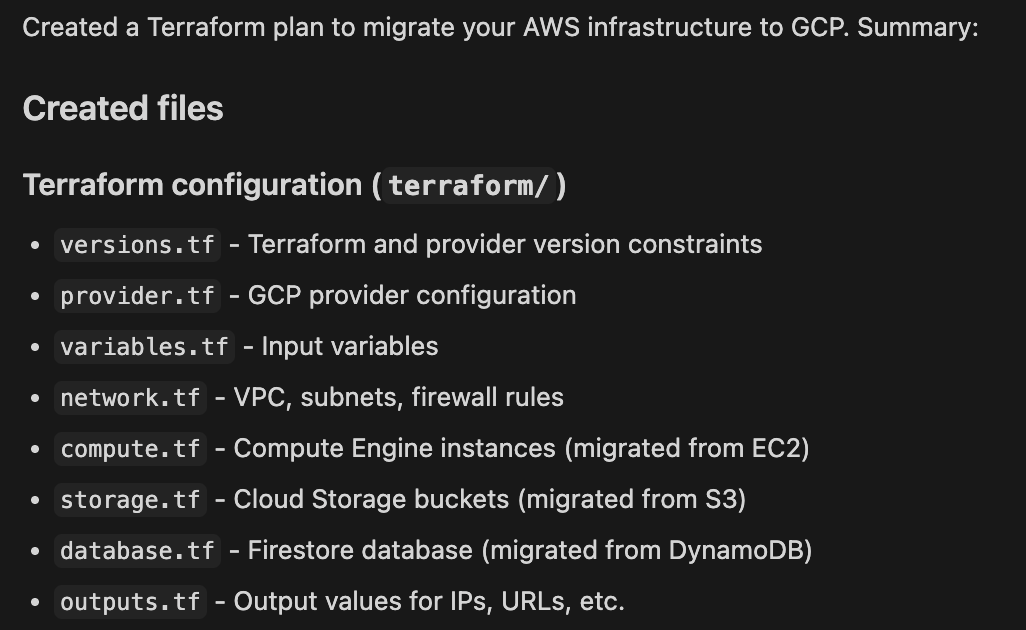
CloudGo produces deployable Terraform optimized for GCP's cost model. Rather than recreating stopped EC2 instances as always-on VMs, CloudGo's IAM configuration with roles/run.invoker signals a Cloud Run serverless strategy, paying only for actual invocations instead of idle compute. For workloads running less than 10% of the time, this can reduce costs by 80-90%. The infrastructure choices reflect cost awareness: us-central1 (GCP's cheapest region) instead of geographic parity, auto-mode VPC instead of manual subnet management, and a single consolidated service account instead of mirroring AWS's IAM user structure. Firewall rules restrict traffic to internal ranges (10.0.0.0/8) rather than exposing SSH to the internet.
Claude's output is a faithful 1:1 translation, great for compliance audits. Cursor’s output is very comprehensive, but ultimately not optimal. CloudGo's output demonstrates migration intelligence, understanding the workload patterns (stopped instances = sporadic use) and choosing GCP-native patterns that achieve the same outcomes at potentially 75-99% lower compute cost.
Part 4: Validation Pipeline Results
CloudGo.ai was the only system to pass Checkov, TFLint, and policy validation with zero critical issues. It automatically resolved security misconfigurations and logical errors before presenting output. Claude’s output failed security validation due to open ingress and overly broad IAM permissions. Cursor’s output failed basic syntax and could not be deployed.
Business gain: Eliminates post-generation security rework, reduces breach and audit risk, and shortens the time from plan to production.
| Validation Metric | CloudGo.ai | Claude | Cursor |
|---|---|---|---|
| Overall Project Status | Passed (Deployment Ready) | Failed (Security Risks) | Failed (Syntax Errors) |
| Security Analysis (Checkov & OPA) |
100% Compliant System automatically identified and restricted HTTP ingress source ranges to ensure compliance. |
Critical Failures Unrestricted SSH/HTTP access, public IP exposure, and default service account usage. |
Critical Failures Public access prevention missing on storage buckets; versioning disabled. |
| Code Quality & Linting (TFLint) |
No Issues Found Resolved duplicate declarations and removed non-existent output references prior to finalization. |
Warnings Detected Boot disks missing Customer Supplied Encryption Keys (CSEK); excessive scope permissions. |
Blocking Errors Invalid multi-line string syntax and unsupported resource block types preventing execution. |
| Automated Remediation | Active Identified and fixed 3 logic/security errors during generation. |
None Requires manual intervention to secure infrastructure. |
None Requires manual debugging to run `terraform plan`. |
Conclusion
Across inventory discovery, cost analysis, migration planning, and validation, CloudGo.ai consistently delivered higher accuracy, lower risk, and deployable output.
General-purpose AI tools lacked live visibility, validation, and accountability, shifting risk back to engineering teams.