 CloudGo
Background
This system design document is based on an engagement with a mid-size technology company that needed to modernize a key business workflow by isolating it into a dedicated serverless microservice. While the organization’s identity has been anonymized for security reasons, the structure, rationale, and architectural decisions presented here accurately reflect the real system we helped them design. Their existing backend was becoming difficult to scale and maintain, and moving to a Lambda-centric architecture offered a path toward greater agility, resilience, and operational efficiency.
With support from CloudGo.ai, they were able to generate a production-ready design in just one day, dramatically accelerating their planning cycle while maintaining technical rigor.
AWS Lambda Microservice Design
1. Executive Summary
This document outlines a production-ready, serverless microservice architecture built on AWS Lambda and supporting managed services. The goal is to deliver a scalable, fault-tolerant, maintainable service using AWS managed components and best practices. It addresses both synchronous API workloads and asynchronous event-driven workflows, minimizing operational overhead while ensuring robustness and observability. This design follows proven AWS serverless patterns and integrates automated CI/CD deployment and monitoring systems.
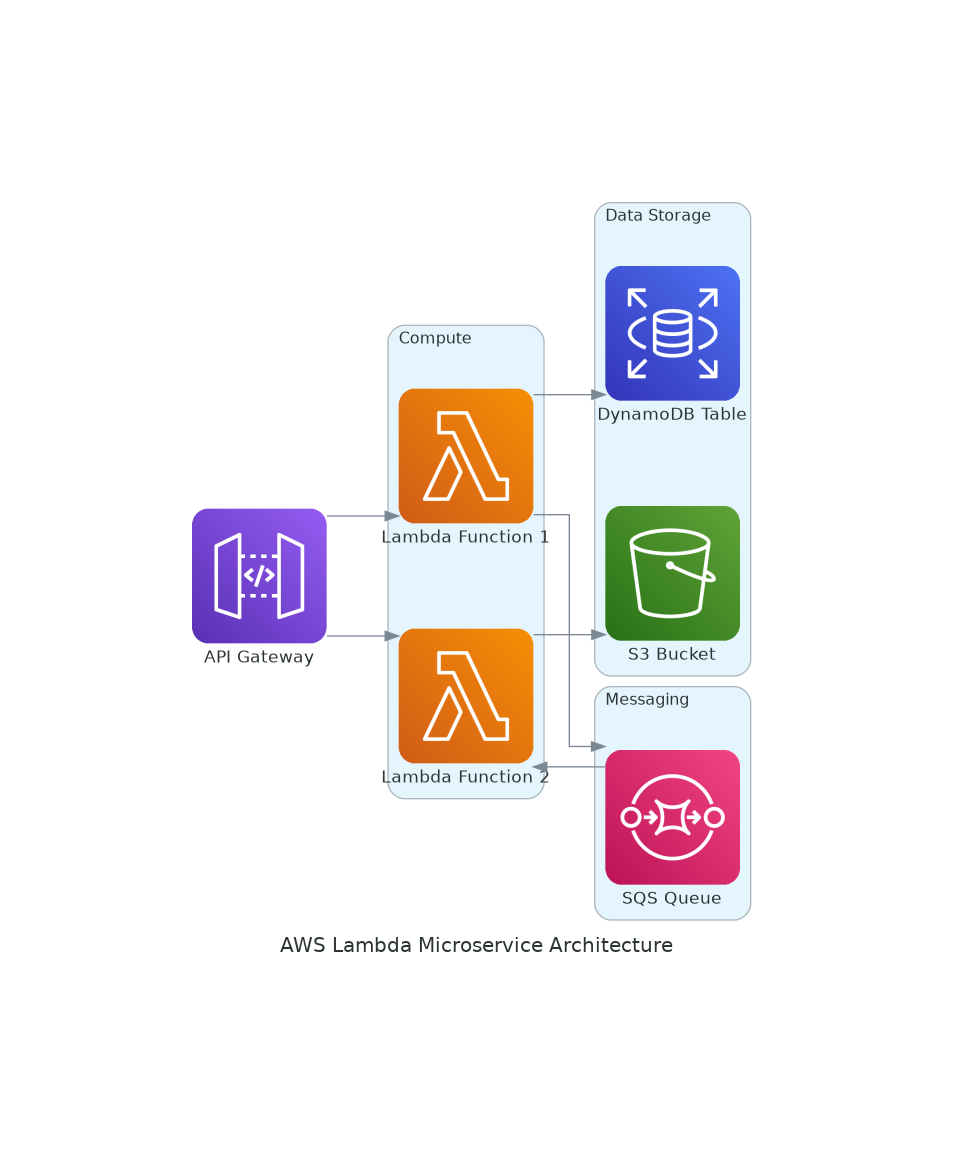
| Component | Role |
|---|---|
| API Gateway | Entry point for HTTP APIs and routing to Lambda functions. |
| AWS Lambda | Stateless compute for business logic, scaling on demand. |
| Amazon DynamoDB | NoSQL datastore for fast, scalable persistence. |
| Amazon EventBridge | Central event bus for decoupled, event-driven workflows. |
| Amazon SQS | Buffers tasks and enables reliable asynchronous processing. |
| Amazon Cognito | Authentication & JWT token issuance for API security. |
| CloudWatch Logs | Centralized logging and dashboarding. |
| CloudWatch Metrics | System metrics and alarms. |
| AWS X-Ray | Distributed tracing for performance analysis. |
| CI/CD Pipeline | Automated deployments via CodePipeline / GitHub Actions. |
2. Service Purpose and Scope
The primary objective of this microservice is to deliver a backend component capable of handling both API-based interactions and background processing tasks in a resilient, scalable, and maintainable way. It provides RESTful endpoints for client applications, orchestrates business actions through Lambda functions, persists state in a NoSQL database, and integrates with other services via a central event bus. Security is enforced through authenticated access, and the service is designed to be observable in production with centralized logging and tracing. This document focuses on synchronous request handling, asynchronous event workflows, and the supporting infrastructure necessary for a production deployment.
3. Architecture Overview
At a high level, this architecture uses AWS managed services to achieve a fully serverless solution that minimizes operational burden. Incoming HTTP requests are received through Amazon API Gateway, which relays them to specific AWS Lambda functions that encapsulate the business logic. The functions interact with an Amazon DynamoDB database to read and write state efficiently, using DynamoDB’s scalable, key-value storage model. Events generated during processing are routed through Amazon EventBridge, allowing other services or components to respond asynchronously. For tasks that require guaranteed delivery, Amazon SQS queues are used to buffer messages. The service uses Amazon Cognito for authentication and API authorization, ensuring that only legitimate requests are processed. Monitoring is centralized via Amazon CloudWatch Logs and Metrics, and performance traces are captured using AWS X-Ray. A continuous deployment pipeline automates the deployment process, enabling safe and repeatable releases.
This pattern supports both synchronous and asynchronous workloads by combining the strengths of event-driven and API-driven architectures. Using API Gateway together with Cognito for authentication enables secure, scalable frontend APIs. Lambda functions provide the core compute without server management overhead, and DynamoDB delivers fast, highly available storage suitable for serverless workloads. EventBridge and SQS introduce decoupling between components, improving resilience and flexibility in processing asynchronous tasks.
4. Component Details
API Gateway Integration
API Gateway serves as the front door for all client traffic. It presents well-defined RESTful routes that are mapped to backend Lambda handlers. The gateway layer handles protocol translation, JWT token validation via Amazon Cognito user pools, and rate limiting to protect downstream services. Caching policies can be applied where appropriate to optimize performance for frequent requests. This integration ensures that traffic is reliably routed and that unauthorized access is rejected at the perimeter.
In serverless architectures, API Gateway commonly acts as the bridge between clients and Lambda functions, converting HTTP calls into function invocations and back into responses.
AWS Lambda Functions
AWS Lambda functions encapsulate the core business logic of the microservice. Each function is scoped to a specific domain operation or workflow stage, such as handling synchronous API requests or responding to asynchronous events. Lambda functions are configured via environment variables for resource references and secrets, keeping deployment artifacts consistent across environments. Provisioned concurrency can be enabled for performance-sensitive functions to mitigate cold start latency, especially under bursty traffic patterns.
Best practice in serverless functions includes writing idempotent code to handle repeated event delivery safely and assigning least-privilege IAM roles to restrict access only to needed resources.
Data Persistence with DynamoDB
Amazon DynamoDB is the chosen datastore for this service due to its managed nature, predictable performance, and seamless scalability. Tables are designed with access patterns in mind, using efficient partition keys and optional secondary indexes to support common queries. Depending on workload patterns, on-demand capacity or provisioned capacity with autoscaling may be used to balance performance and cost. DynamoDB can also emit streams that Lambda functions may consume for further processing or integration with other workflows.
DynamoDB’s key-value and document model fits naturally with serverless microservice use cases, offering high performance at scale.
Event-Driven Workflow
Asynchronous processing is handled through a combination of EventBridge and SQS. When a Lambda function needs to notify other parts of the system about a change in state or trigger a background task, it publishes an event to EventBridge. EventBridge then delivers that event to interested consumers or targets, enabling decoupled processing. For scenarios where guaranteed delivery and retries are necessary, SQS queues provide durable message buffering. Lambda functions poll these queues and process messages in a reliable fashion, with dead-letter queues capturing failures for review.
This event-driven pattern helps to decouple components, enabling scalability and resilience in the face of varying workloads.
Authentication and Authorization
The service uses Amazon Cognito to handle user authentication, sign-in, and token management. API Gateway validates JWT tokens issued by Cognito before invoking any backend logic, ensuring that only authorized clients can access protected endpoints. Internally, Lambda functions run with restrictive IAM roles that grant only the permissions required to access DynamoDB tables or publish events, adhering to the principle of least privilege.
Observability
Observability is essential for operating a microservice in production. This design captures application logs centrally in CloudWatch Logs, enabling developers and operators to review execution traces, errors, and contextual metadata. CloudWatch Metrics provide numerical insight into performance and health, while configured alarms notify stakeholders when thresholds are breached. AWS X-Ray is enabled to trace requests across API Gateway and Lambda, providing visibility into latency and bottlenecks within distributed workflows.
5. Non-Functional Requirements
This service must scale to accommodate high variability in demand without manual intervention, targeting throughput in the hundreds of requests per second while maintaining stringent latency goals for interactive APIs. Built-in multi-Availability Zone support of AWS services ensures resilience and high availability. Security is enforced at multiple layers, from encrypted transport to strict identity and access controls. The architecture is designed for operational excellence, with infrastructure defined as code and deployments automated through a CI/CD pipeline that supports safe rollout strategies such as canary or blue/green deployments. Observability ensures that issues are detected and diagnosed quickly, and asynchronous processing includes retry logic and dead-letter handling to maintain reliability.
6. DevOps considerations
Infrastructure is defined and managed using Infrastructure as Code tools such as Terraform, AWS SAM, or the AWS Cloud Development Kit (CDK). A continuous integration and deployment pipeline is implemented using tools like AWS CodePipeline, GitHub Actions, or equivalent, automating testing, building, and deployment of both function code and infrastructure. Deployment strategies are structured to minimize user impact, employing traffic shifting and staged rollouts to validate changes before full propagation.
In shaping this design, several trade-offs are acknowledged. Coarse versus fine granularity of Lambda functions influences both operational complexity and performance; finer granularity increases isolation but requires more coordination. Provisioned concurrency reduces latency at the expense of cost, so it is selectively applied to critical paths. Decoupling with events enhances resilience but adds complexity to tracing and error handling. These considerations inform design decisions and align with patterns used in production serverless systems.
7. Cost & Budget Reference
Refer to the Infracost estimate Below for projected monthly cost breakdowns across API Gateway, Lambda invocations, DynamoDB usage, SQS/EventBridge traffic, and monitoring services.
This cost estimate provides insight into monthly spend projections and is essential for operational planning.